The short answer is that many of our classroom expectations are truly to maintain control rather than promote curiosity, freedom, and healthy child development.
With the start of the school year upon us or shortly behind or ahead of us, I have been reading tweets and posts and blogs about classrooms expectations, rules, and procedures. Recently I read a post by @CarlaShalaby regarding 8 questions we should ask ourselves when we are creating our rules and polices. She makes a great point that “how we manage a space can be a chance to practice freedom instead of modeling control”.
The 8 questions come from various sources including Lessons in Liberation: An Abolitionist Toolkit for Educators (AK Press, 2021).
Questions to consider:
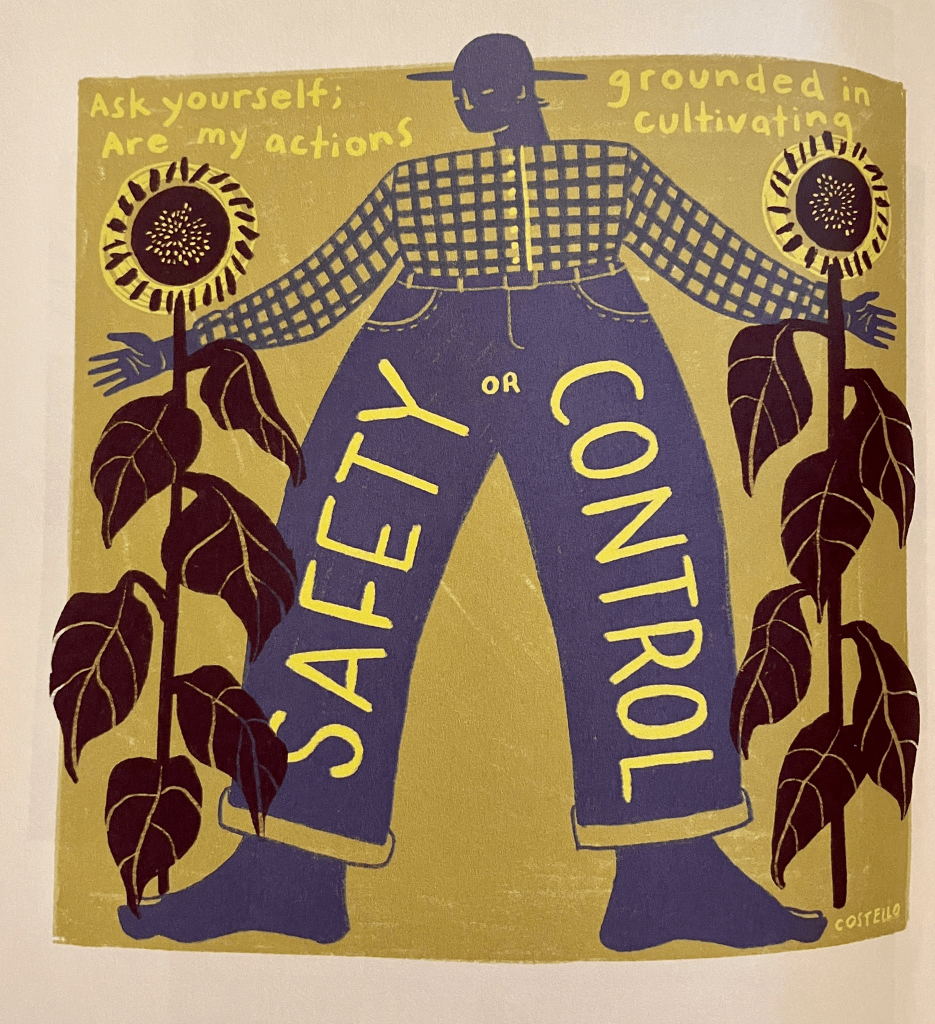
- Are my actions grounded in cultivating safety or control?
- Am I defining safety in a way that requires control or freedom?
- Freedom means that we keep us safe, we protect everyone’s bodies and feelings.
- Does enforcing the rules require me to behave like a police officer or an educator?
- If a student asks “why?” will your reason for having the policy stand up to the uniquely smart and relentless scrutiny of 30+ young people collectively seeking freedom?
- Does this rule exist only because I have a personal pet peeve?
- Am I serving kids by having a comprehensive set of rules that eliminates all potential conflict, harm, and drama?
- Do I want to model how to use power to manage people in a space, or how to use it to hold and make space for everyone?
- Why do I teach?
This artwork by Molly Costello is a great visual for the ideas represented in these questions.
These questions also align with a few questions recently proposed on the same topic by Dr. Kristopher Childs, Chief Academic, Social Justice, and Equity officer at Open Up Resources. He argues we should consider:
- Have I created an environment where all students can achieve success?
- Do all students have windows, mirrors, and doors to see themselves, learn, and experience other cultures?
- Do I truly believe that all students can be successful?
- What pieces of themselves are students forced to leave at the door when they enter my classroom?
These ideas remind me of some of the common practices we see in our schools such as clip charts in elementary grades, rewards in a PBIS model, and the variety of expectations from classroom to classroom on middle and high school campuses. If we want to truly create environments that are safe and welcoming spaces for our students then we have to take a serious reflective look at the normal practices we believe to be necessary in school.
To be clear:
- Clip charts are a form of bullying. No adult would allow an employer to use these in a group setting. Stop doing it to children.
- Rewards in most situations only work when people want the reward and when their are observers present to see the desired behavior. Rewards kill intrinsic motivation.
- Students in middle and high school settings typically have 6-8 sets of rules and expectations about pencil sharpening, bathrooms breaks, water, etc. This creates mental chaos as they move from one space to another. Work to create common expectations and free up mental space for students to learn.
Thank you to @CarlaShalaby for inspiring this writing and to @DrKChilds for his thought provoking questions. I love number 4.
What do you have to leave at the door when you enter a space? Work? Home? With friends? With family?
 Math Hiker Blog