Category Archives: Math Philosophy

Can we just let this practice go?

Yes, we CAN just let homework go!

As a classroom teacher the routine of assigning, grading, and chasing down of homework was the bane of my existence. For many years it was the reason I was grumpy on Sunday evening. Grading it, giving feedback, and recognizing who hadn’t completed it put me in a bad mood. This coupled with the constant effort to find ways to engage students with homework was miserable. When I thought more about it and watched student behavior while returning work, I realized they didn’t value the feedback the way that I wanted them too and they only saw homework as a compliance behavior. It was something they had to do with little purpose or connection to learning.

It was blissful when I gave up grading homework and just changed it to optional extra practice that would enable them to be more successful on other assignments that were graded. Guess what…the same number of kids did the work.

There has been some analysis of educational research by John Hattie and his Visible Learning work that shows homework has virtually no impact on student achievement in grades TK-8 and little impact in high school. Peter Liljedahl in Building Thinking Classrooms shares that through student interviews we now understand that student view homework very differently than we do. They see it as compliance and we see it as an opportunity to continue their learning. Traditional homework practices do not achieve what we hope.

I guess there is an argument that could be made around work ethic. Homework could help to build work ethic, perseverance, and grit in students. To this I would say there are plenty of other aspects of life that do this far more effectively.

I think if we are honest with ourselves as educators we should acknowledge that copying is rampant and the students who need the practice the least are the ones doing the work.

Finally, let’s think about reality. Kids are insanely overscheduled. They have wonderful activities outside of school or after school programs they participate in and learn through. They don’t need more work to do. Also, educators can focus more on designing engaging lessons or reading current educational texts rather than grading if you get rid of this practice.

Give this practice up. Homework can die. Let it die. Mourn it. Through a party. Do whatever you need to in order to feel better about it. Just let it go as a compliance task.

If you need to, do what I did, post problems that students can do for more practice if they choose to and remind students that the extra practice will improve how they do on graded assignments.

Stop grading it for compliance and gain back valuable time while creating better relationships with parents and students.

Can we finding math in our environment? Part 1

Yes! It is everywhere.

When I am not working in the field of math education, I am spending time with my wife and son. One of our favorite things to do is to explore while hiking and camping.

This past November we traveled with friends through northern Nevada and Arizona and were fortunate enough to see Valley of Fire State Park in Nevada, The Vermillion Cliffs National Monument, and Wupatki National Monument. These areas were a reminder of the wonderful power of nature, the resilience of humans, and that we live on the stolen lands of the First People that came before us.

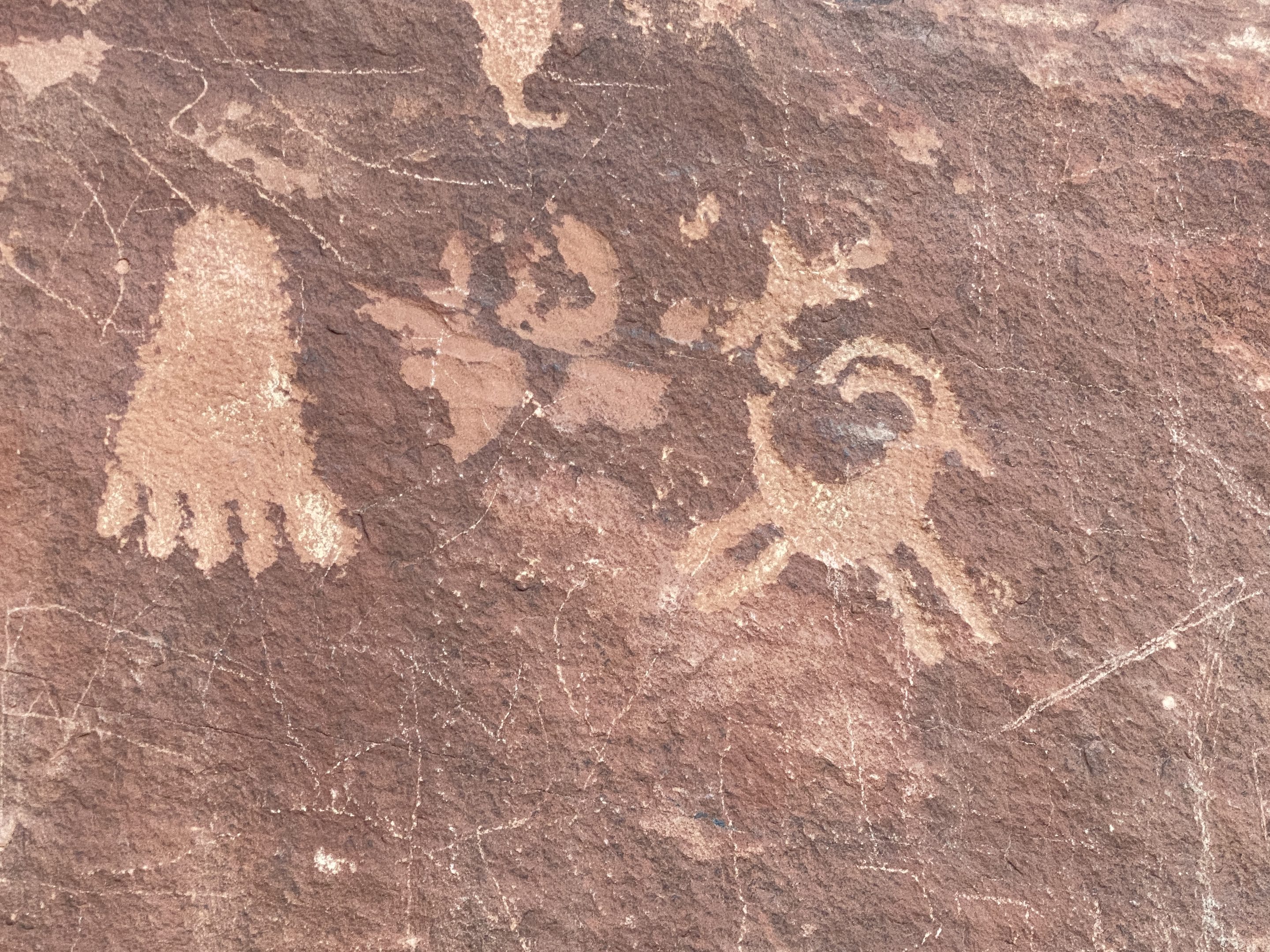
Here you can see amazing pictographs from the Valley of Fire State Park and the evidence of the rich culture of the First Peoples of this region. Sadly, you can also see the damage done by visitors of this site.

You might be wondering where the mathematics is in this. I would argue that is because our mathematics culture in the United States erroneously equates only calculations with mathematics. We have to shift that narrative.

Mathematics is embedded in all that we do. It is the unspoken language that helps us makes sense of our world and cultures that came long before us have made amazing mathematical achievements that I am still striving to learn more about. We make sense of our world through scaled/proportional drawings such as those in these pictures. We mathematize our world when we think of group size and how that relates to our own health, welfare, and comfort. You could consider this looking at this picture of Big Horn Sheep below that wandered through our campground. In a different time one of these could have provided food for a community. Consider how much food, for how many people, and for how long.

We can mathematize a beautiful scene such as the bridge with a backdrop of the Colorado River just west of the Navajo Territory in Eastern Arizona that you can see below.

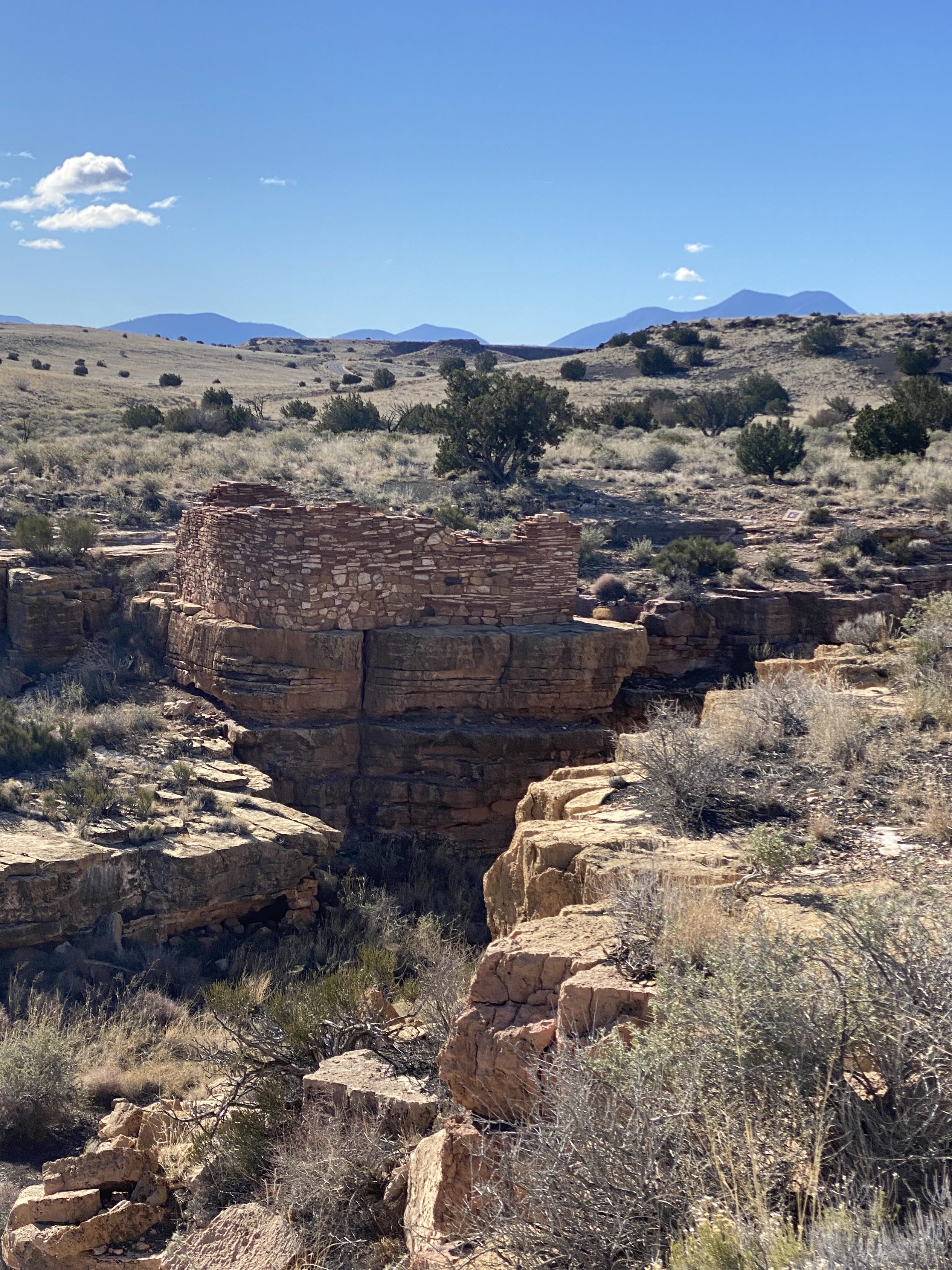
Finally we can consider area of a living space, location, storage of food stuffs, and conditions that may have contributed to life span when we explore the ruins seen below from Wupatki National Monument or the Pueblo Bench Archeological site in The Vermillion Cliffs National Monument.

Mathematics is all around us. It is in our histories, our communities, our stories, and our interactions with these things. Look for it, help others see it, and our world becomes a better place.

I hope you all have a joyous end to 2022 and I will write more in the new year!

Is there a place for competition in TK-5 classrooms?

The short answer is ONLY if students choose to compete. This should always be 100% their choice.

Collaboration promotes more learning than competition. This is true for students and adults. The reality is that there are many instances of competition that are implied throughout our classrooms systems in TK-5 education and beyond. For my purposes today we will focus on our youngest learners in grades TK-5. We have to remember that while many of our students like school for a variety of reasons they are still required to be there. If we require them to compete with one another overtly or otherwise we run the significant risk of diminishing their agency, the belief in themselves as mathematicians, and their love for learning. I don’t believe there is a single teacher whose goal it is to do this. We all want our students to thrive in our classrooms.

If we truly want our students to thrive we have to regularly reflect on how our chosen practices effect our students. We should pay particular attention to how our practices effect the least vocal, marginalized, and average students. Often times we hold up certain practices because we focus on the excitement of a few kids while not recognizing the reticence of many in the classroom. Continuous reflection and curiosity is essential as an educator.

A great example of this are the charts we see in many elementary classrooms that track progress for such things as math facts acquisition, number of books read, or other whole class record keeping that is public. These charts are a form of passive competition and the students are not getting to choose whether or not they compete. Imagine how the 5 students with the least stars/stickers on the chart feel looking at this public display of their performance. Does it inspire them to work harder or does it seem like a reinforcement of their public or self-perceived lack of ability? I would argue it is the latter. These charts should never be public. Take them down. They are not having the effect for our most struggling students that you would hope.

Timed math fact tests are another example. The general consensus among math educators is that these tests that hopefully WERE so prevalent in our classrooms a decade or more ago are bad for student motivation, create math anxiety, and do not provide us the insight into student learning that we think they do. But is there possibly a place for these tests. I might argue yes. If students are only competing against their own best times, if it is never whole class or required, and if students get to choose when and if they compete. This could be a “may do” for some students who express a desire. There are some students that enjoy pushing themselves in this way but they should be the one choosing to participate. The key is to be flexible within your classroom, be curious about your students and what they like and don’t like, and offer them choice.

Remember as adults we get choose if we compete, with the exception of public displays of state test data. Do any of us like it when this happens? As an example, we aren’t all required to play on an adult league sports team regardless of interest or ability. That would be insane. Competition is fun when we participate because we choose to compete. Let students choose! Reflect on your practices this summer and how you can utilize competition in your classroom for those who want to compete and eliminate it for those that don’t. It should be 100% student choice on a day to day basis.

Have a great summer! Keep being curious and keep learning!

Why is it all about curiosity?

Here is my quick answer … To quote authors Shane Safir and Jamila Dugan, “We should be trying to maintain a stance of wonder”.1 Curiosity (or wonder) is the basis of all learning. If we are truly curious then we would not make assumptions about or judge others, we would ask questions and first seek to understand ourselves, our students, their families, and our systems.

Several years ago the district I worked for had all of its managers go through several days of training around determining our district “why” using the work of Simon Sinek.  One of the core ideas I learned from this work was that to truly have a “why” that drives you, it has to be grounded in both your personal and professional life.  After thinking and refinement I realized that my WHY was a belief in a world that valued curiosity and discourse.

I truly believe that all teachers want their students to enjoy learning, be curious about the world, and be lifelong learners. If we want students to enjoy learning it starts with curiosity. Curiosity is cultivated when students are answering questions they have asked. This isn’t as hard as it might sound. Take a look at that next problem you want to solve with students, remove the question, and ask kids what they notice and wonder. Ask them to come up with mathematical questions about the situation. They will likely ask the question that you want answered but they will have the best reason to be interested in the answer – they’re asking the question. This isn’t perfect yet it allows the problem/situation to be driven by student curiosity. 

As practitioners we also must realize that curiosity is not cultivated in isolation.  Math is a community endeavor and should be done in partnership with other students.  Collaboration is the only road that leads to deep thinking and learning.

So let’s ask ourselves … How often do we ask our students to be curious in math class TK-12?  Are there opportunities for curiosity in your lessons? Do you value curiosity in your students as a means of learning? How do your homework assignments value curiosity?  Are you curious about what mathematical knowledge your students bring to class?  Are you curious about what mathematical understanding you could more deeply develop in yourself? These and many other questions like them can help frame the shifts we make in our classrooms. 

Teachers can make a few simple shifts to transform their classrooms into curiosity generating environments.  Teachers and administrators can begin by shifting how we view ourselves.  We can shift from viewing ourselves as teachers to teacher-learners who are curious in their own right about the process of facilitating learning.2 In elementary school we can also be curious about how we are teaching mathematics.  Is our daily instruction focused on acquiring skills or models, following a textbook, and/or direct instruction?  Or are we helping students to be curious about how the operations of addition, subtraction, multiplication, and division behave.  “Children spend much of their time in mathematics solving individual problems.  But the core of the discipline of mathematics is looking across multiple examples to find patterns, notice underlying structure, form conjectures…”.3 Curiosity is at the heart of concept and our discipline. We need to start taking more advantage of curiosity and reimagine the way we teach mathematics. 

We often design lessons or follow textbooks or pacing guides that do not promote curiosity or take into account what mathematical knowledge our students already bring to the classroom. As the founders of Make Math Moments explain, if you want to generate curiosity-rich math lessons, then you should embed these 4 key elements: 1) Withhold information; 2) Build anticipation; 3) Notice & Wonder; 4) Estimate (Make Math Moments 3-Part Framework)

As a final thought, when we shift to a stance of curiosity we put student sense-making at the forefront of our planning and instruction.  As an example, when we make this shift, the algorithm becomes a representation versus the finish line.

I have an elementary age student that helps remind me of my “why” every day.  I believe in a world that values curiosity and discourse.  I want nothing more than for him to maintain his curiosity about the world. If he does then learning will always be his compass.

References

  1. Safir, S., Dugan, J. (2021). Street Data: A Next-Generation Model for Equity, Pedagogy, and School Transformation. Sage Publications Inc. 2021
  2. Ostroff, W. Cultivating Curiosity in K-12 Classrooms: How to Promote and Sustain Deep Learning. ASCD, Alexandria, VA. 2016.
  3. Russell, Susan Jo, et al. Connecting Arithmetic to Algebra: Strategies for Building Algebraic Thinking in the Elementary Grades. Heinemann, 2011.

Why do people hate math?

Here is my quick answer…many people are afraid of math because they grow up being unsuccessful and hating “school” math and the education system as a whole isn’t concerned with whether or not students enjoy learning.

A few weeks ago a colleague asked “why are people afraid of math?”. It was a good question and it was asked sincerely.  People in our society regularly say they are “not a math person” or freely admit “I was never good at math” or, my favorite, “you taught middle school math, bless you.” Others are regularly impressed with people who are good at math.  As if we are somehow smarter than other people because we teach and/or understand math (or at least we seem to). The question has plagued me for several weeks, and it is the reason why I finally decided to write some of my thoughts down to share.

For a moment I’d like to share that I do not believe myself more qualified than any other math education professional to write about the teaching and learning of mathematics.  In fact, many of the ideas that I share are those of others which I will give credit where credit is due.  I truly stand on the shoulders of those around me and those who came before.  That being said, perhaps the way the ideas are shared might be exactly what and how you need to hear them.

As for the question at hand: Why are people afraid of math?  Truly I don’t believe people are afraid of math. A fear of math is just the manifestation of our fear of failure.  No one wants to seem inadequate or feel like a failure at anything.  In fact we naturally avoid things we regularly fail at. I can’t think of a person that would willingly continue to try something they have been made to feel a failure at for years.  When we reduce mathematics to sets of skills and procedures through instructional methods like “I do, we do, you do” and strict sequential following of a textbook (just to name a couple), we convey to students the ideas that if you aren’t good at the procedures and don’t “master” the skills then you must not be good at math.

If we accept this as a possible premise, then the real question is why do people feel a failure in their relationship with math.  While there are many possible reasons, my thoughts continue to return to the role that our educational system plays in our society’s dislike for mathematics.  We must acknowledge that most of the mathematics we stress in elementary and middle school is a by-product of an age prior to the ubiquitous availability of computers.  And yes that thing we call a phone in our pocket, that is a computer.

The key idea here is that young students bring an exceptional intuitive knowledge of mathematics to elementary school.  Simply reference the research and success of Cognitively Guided Instruction in grades TK-5. Our pacing guides, textbooks, and the breaking down of knowledge into unconnected procedural steps leads children to believe that math is nothing more than memorizing these unconnected procedural skills.  When children fall behind the pace set by districts, schools, and textbooks they inevitably begin to construct a negative relationship with mathematics. Combine all of this with grading practices that do little to convey what children truly know, ability grouping in elementary, tracking in middle and high school, a focus on speed and memorization, and intensive intervention and all you get is a large group of children that feel like failures at mathematics. These practices and programs play a major role in producing the fear and disdain that so many people have for mathematics.

The truth is that we need a drastic change in the way that we teach mathematics and many other subjects.  To quote one of my favorite mathematicians, Dan Finkel, “we can’t afford to misuse mathematics to create passive rule followers.”  We live in an age of technology that provides unprecedented access to information.  We have to begin to teach as if these tools exist.  We must stop ignoring these tools, stop being frustrated by students who use them to work around our assignments.  We have to truly change our instruction to provide more authentic learning for students. 

How do we do this?  It begins by recognizing that our personal understanding of mathematics needs to be deeper than it currently might be.  We can also move toward more humanizing practices by standing up and saying, “I have more to learn about the openness of mathematics.”  Most importantly we can begin to shift our instruction by deeply believing that a textbook is not the solution, it is a resource at best. If we truly believe this we must then ask, what should I be using/doing. And thus begins your journey of learning and exploration. What a wonderful journey it will be!

We have to focus on teaching students to see relationships and connections in mathematics.  This cannot be done through direct instruction alone.  We have to recognize that when we provide answers to basic questions or solution pathways prior to student exploration, we rob students of true learning. Essentially we need to redefine what we want from math education.  Algorithms, procedures, skills, and improved standardized test results cannot be the sum of our ambition. 

I will write more on this topic in future posts with specific teacher recommendations.  For now I challenge districts, sites, and teachers to want more for our elementary age students than simply doing well on SBAC tests, covering required content, and automaticity of basic facts. These goals will not lead to increased numbers of students seeking STEM fields and it will not rehumanize mathematics for our students of color. 

And middle school teachers, your students knowing their basic facts will not fix the issues in your math classroom and will not make it significantly easier for students to learn your grade level content.  I used to believe it would but I was wrong. If you do believe this to be true, give them a calculator, and see if that solves the problem because it should but it won’t.

To be clear, I completely recognize the benefit of students gaining automaticity with facts. It can make future math easier to understand but this should not be done by sacrificing understanding of the operations.  Students should understand how the operations behave and how to derive facts they have trouble automatizing. Timed tests and rote practice are not achieving the goal we hoped and they are anxiety producers for students.  The fear and anxiety that these practices  foster in students is not a trade off that is worth making for any reason.  

Curiosity should be cultivated first and centered always!