Yes we can! We can plan our lessons starting with the Standards for Math Practice and focus on student sense-making.
I have been pondering this idea for a long time as I am sure many math teachers do from time to time. How can we focus on the SMPs as drivers of our instruction? How do we incorporate them in meaningful ways?
The reality is that the SMPs are rarely the focus of math instruction, they are embedded in textbooks in superficial ways, and they are difficult to quantitatively assess. The SMPS are listed below and there are great grade level explanations of each SMP in the current CA Math Framework (2013).
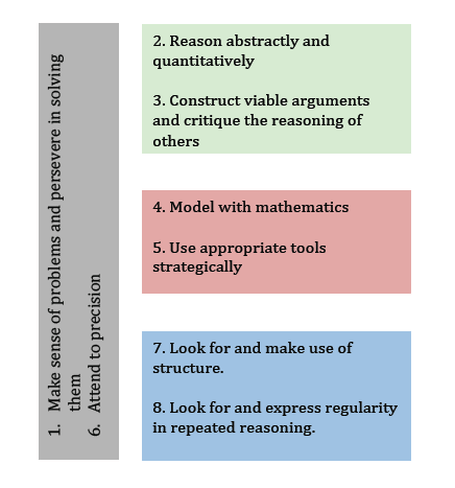
I argue that in order to create a more creative and critically thinking society we have a responsibility to focus on the SMPs in our math lessons. Remember, these are the habits of mind that we want to impart on all students. Focusing primarily on the computational/procedural side of mathematics with NOT get us to the reasoning, communicating, and curiosity our students need to solve current and future global problems.
So how could we do this:
- Start with identifying a focal SMP for a lesson or series of lessons
- Anticipate student successes and struggles
- Script possible facilitating questions that align with the SMP prior the lesson
- Jump in, reflect, and refine future lessons
Here is an example from 3rd or 6th grade multiplication:
I often think of area models as an example. If you consider lessons around introducing 3rd graders to multiplication through area models you could focus on SMP 4 – Model with mathematics or SMP 3 – Constructing viable arguments.
Depending on which of these SMPs you are focusing on will change the questions and structure of the same lesson.
- If you focus on SMP 4 – Model with mathematics … then sequencing student work so that students see both horizontal and vertical models or using a routine such as Connecting Representations
- If you focus on SMP 3 – Constructing Viable Arguments … then the mathematics could easily be embedded in a contextual problem. The 3-Reads or Decide and Defend routines could be utilized and students are given time to solve using their own method. Following that the teacher would ask student to justify their and their classmates’ reasoning.
As an alternative and a parallel to these ideas I also offer this reminder from Dan Meyer’s TED Talk from 2010.
Shifting instruction at all grade levels towards facilitation and away from lecture is essential in preparing our students for their limitless future. There are many ways to achieve this and I offer this post as a way to reach this end.

 Math Hiker Blog